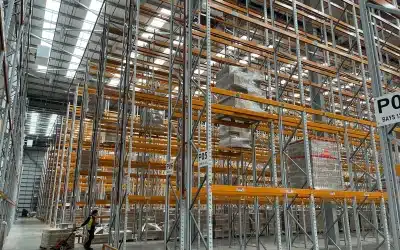
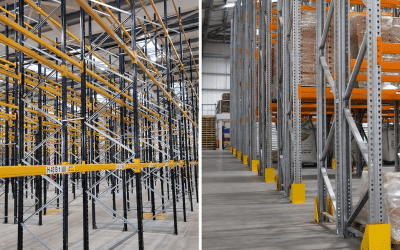
When planning pallet racking, there is no single fixed maximum height that all pallet racking must stay under. The safe and legal height depends on a combination of factors: building characteristics, equipment, safety standards, structural requirements, and operational concerns. Below are the key considerations, regulations, and examples to guide decisions.
Key Factors That Determine Maximum Height
Here are the major influences on how high pallet racking can safely and legally go:
Building Height & Roof / Eaves Constraints
- The height to the underside of the roof, roof trusses, lighting, sprinkler systems, services (pipes, ducting, cables), etc. will often limit how high you can rack.
- Usually, regardless of pallet racking, these obstructions need sufficient clearance from the topmost load and in gangways
Forklift / Handling Equipment Reach
- The lift height of your forklift trucks (or other machinery used to load/unload pallets) must be sufficient to reach the top levels safely. If your equipment can only lift to 5000mm – 6000mm safely, then installing racks above that may be impractical or unsafe.
- With high-bay racking (automated cranes), you can go much higher (even up to ~40m in some cases). But those are specialised installations and require special design.
Structural & Stability Requirements
- Pallet racking must be stable, which involves accounting for the upright frames, beam strength, floor fixings. Height-to-depth ratios are important: as racking goes taller, depth (and bracing) must scale to maintain stability.
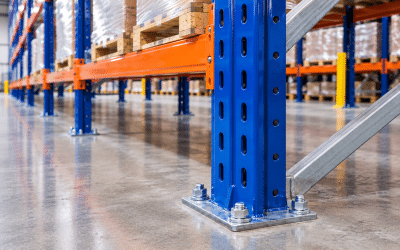
- Floor strength is crucial: the loads transmitted by high pallet racking can be large, and the racking must be anchored properly. If you’re using racking not fixed to the floor, there are stricter limitations.
Clearances and Safety Standards
- Vertical clearance between the top of pallet load (or pallet + load) and the beam above must meet certain minimums. The SE (Storage Equipment) / SEMA codes and BS/EN standards (such as DIN EN 15620) define required clearances.
- Also horizontal clearances (between loads, aisles, between load and uprights) are governed by standards.
Health & Safety and Regulatory Compliance
- Regulations such as the Health and Safety at Work etc. Act, PUWER (Provision and Use of Work Equipment Regulations), and HSE guidance demand that storage systems are safe, inspected, maintained.
- SEMA (Storage Equipment Manufacturers Association) has Codes of Practice for static pallet racking. Complying with these is usually required, especially if there’s ever an inspection or liability issue.
Operational Practicalities
- Accessibility: how often do you need to access the top levels? Is it daily, weekly? If frequently, high pallet racking may slow operations due to times when lift trucks wait, safety checks, etc.
- Visibility & safety: as you go higher, visibility for drivers becomes worse; risk of dropped loads increases.
- Cost: both of the pallet racking itself and of the machinery needed to reach higher shelves (higher capacity lifts, safety features etc.).
- Fire safety: higher pallet racking may affect fire suppression systems and response, sprinkler coverage etc.
What Heights Are Being Used / Examples
To give a sense of what’s practically done in warehouses:
- Standard warehouse pallet racking is often in the range 2500mm to 5000mm high for many operations. Kits and bays are commonly offered in these heights.
- For deeper specialist/high bay installations, heights of up to 40,000mm are possible using automated cranes.
- Suppliers generally offer frames up to 5000mm – 6000mm high even in manual forklift operations. For example, kits up to ~5000mm are seen in many places.
What the Regulations & Codes Say
Here are some of the relevant codes, standards, and legal sources:
- SEMA Code of Practice: UK body for storage equipment; provides guidance on depth, overhang, beam clearances, etc.
- HSE Guidance, e.g. Health and Safety in Warehousing & Storage (HSG76), which doesn’t specify exact racking heights but emphasises stability, safety, inspection, handling of risk.
Key Limitations / Red Flags
Watch out for these issues which often force reductions in height:
- Insufficient headroom or obstruction from building services.
- Forklifts or reach trucks not capable of safe lifts to required height.
- Excessive height increasing risk of damage (falls, load drop), complicating inspections.
- Floor not strong or level enough; uprights not properly anchored.
- Fire safety compliance: sprinkler coverage, delays due to height.
- Maintenance and inspection difficulty at high levels.
Conclusion & Takeaways
- There is no single maximum legal height for pallet racking in the UK: it depends on a wide range of site-specific, equipment-specific, safety, and regulatory factors.
- For most “normal” warehouse setups with conventional forklifts, the practical heights are often 4000mm – 7000mm, sometimes up to ~10,000mm, depending on building and machinery.
- With automated high-bay systems, heights up to 40,000mm+ are possible – but these are specialist and costly.
Planning a new warehouse layout or a new set up? You can download our handy Pallet Racking Heights Checklist or our Pallet Racking Heights Tips sheet. For more information you can contact us on 0800 612 3210