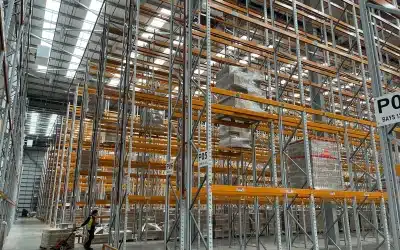
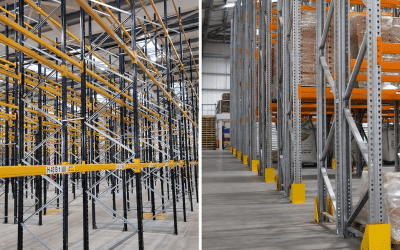
Ensuring a secure installation of your pallet racking system is crucial for the safety and functionality of your warehouse. In this blog you will find the answers to your pallet racking questions, including its installation and maintenance. If you don’t find the answers that you are looking for, feel free to call us on 0800 612 3210. Our friendly team is always happy to help!
What is pallet racking?
Pallet racking consists of shelves supported by frames arranged in horizontal rows for storage. The terminology for a pallet racking systems includes:
- Frame: The upright section of the racking, made up of two vertical upright posts connected by diagonal and horizontal bracing. The frame width is usually set to either 900mm or 1100mm.
- Beam: The horizontal, load-bearing structures that connect the two frames. When two beams are attached to the frames, they form a ‘beam level,’ where products or pallets are placed.
- Bay: A single bay comprises of two frames and the beams that connect them.
- Run: A continuous row of joined bays.
- Shim: These are used when the uprights are positioned on uneven floors. The shims, which match the size of the uprights’ base, are placed underneath to level the frames.
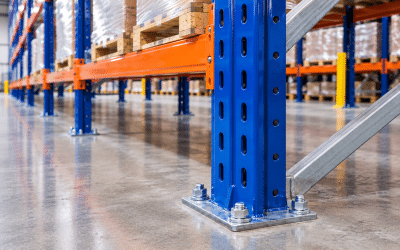
- Footplate: Can be referred to as baseplates, these are located at the bottom of uprights and serve as anchors to enhance stability. Anchor bolts are inserted through the holes in the baseplates to secure the frames to the concrete floor.
Can I adjust the pallet racking and beam levels after installation?
Load notices provide essential information about how to use shelving or pallet racking systems safely, including the maximum weight they can hold. These signs help ensure safety by informing staff about proper loading procedures. When displayed clearly and supported by proper training, they reassure businesses that employees know how to use the storage systems safely.
Should my pallet racking be fixed to walls?
No, we do not recommend this at all! It poses a risk of causing both the pallet racking and the walls of your building to collapse in the event of an accident.
You must investigate any securing of pallet racking to the external walls of your building. You may need to check the building insurance, building regulations and codes before you attempt fixing a pallet racking structure to the building walls. This is not an exhaustive list and there may be other checks that need to be carried out before you can safely attach any pallet racking to structural walls.
What is the recommended distance my pallet racking should be from the wall?
Maintaining adequate clearance between pallet racking and the wall is crucial for safety, access, and ventilation. The recommended distance varies based on factors such as the type of goods stored and the equipment used. Generally, you should keep at least 6 inches (15 cm) of space between the wall and the pallet racking system. This spacing helps prevent damage to both the pallet racking and the wall and ensures proper air circulation, pest control, and fire safety.
How do I secure my pallet racking?
To ensure the safety and integrity of your storage system, secure your pallet racking to a concrete floor using anchor bolts designed for concrete applications. This involves drilling holes into the concrete, aligning the footplate, and securing them with the bolts. Use the correct type and size of anchor bolts specified by the pallet racking manufacturer. Also ensure that you install them to the appropriate depth and torque.
The number of bolts needed for each upright of your pallet racking depends on a number of factors. Such as the height and capacity of the racking, the type of floor, and environmental conditions like seismic activity. SEMA recommends securing each footplate with at least one anchor bolt. However, at Shelving & Racking, we supply you with four bolts per frame free of charge. More may be necessary for heavier-duty applications or higher racking. Always refer to the manufacturer’s recommendations and applicable safety standards to determine the appropriate number and size of bolts.
Do I need to have my pallet racking inspected?
If you are an owner or user of a pallet racking system, the answer is yes. You will need a racking inspection from a SEMA approved racking inspector at least once a year and regular racking safety inspections from competent staff. This is HSE’s advice as outlined in HSG76 Warehousing and storage: a guide to health and safety. It’s not legally binding, but following the advice in this document means that “you will normally be doing enough to comply with the law”.
Are pallet racking inspections a legal requirement?
The short answer is no, but several pieces of legislation and government guidance suggest they are a good idea. HSE’s guidance mentioned above recommends yearly inspections from a SEMA approved racking inspector and regular pallet racking inspections from competent staff.
Then there are the Provision and Use of Work Equipment Regulations 1998 (PUWER). These regulations outline the need for work equipment – which includes pallet racking – to be inspected after installation or if the equipment is damaged in any way.
Finally, there is EN 15635. This European standard states that pallet racking should be inspected by an expert at least once a year. This mirrors HSE’s advice on the topic. Though this European Standard doesn’t mention SEMA approved racking inspectors specifically, HSE does and so using SEMA approved racking inspectors (SARI) for your expert inspections will be enough to comply with this European Standard.
What is splicing?
Splicing involves adding a component to an existing pallet racking section to reinforce its structure. Various splicing kits are available, each designed for a specific brand of pallet racking. Note that manufacturers have specific splicing requirements based on their pallet racking designs.
A splice design typically relies on end bearing between the upper and lower uprights. Proper cutting and placement are crucial to maintain load-bearing capability. Uprights, the vertical columns giving the racking its height, are the most common parts needing splicing. Regular safety checks of splices are essential, just like for all pallet racking. Position splices above the first beam and higher than 1.5 meters, ensuring there is no more than one splice between any two adjacent beam levels.
Use splices primarily to extend the height of pallet racking. They can also replace damaged sections of a pallet racking upright.
How can I protect my pallet racking from impact damage?
We recommend that you consider using steel column guards for the frames and rack end protection for the ends of the aisles.
What is the best way to stack pallet racking for transportation?
To prevent damage to pallet racking during transport, we recommend the following:
- Use steel banding to securely strap the items together.
- Stack pallet racking frames and beams separately for transport.
Frames:
- Band frames in packs of 15.
- Arrange them top to tail and interleave them.
Beams:
- Band beams in packs of 40 (20 pairs).
- Arrange them top to tail with the flanges oriented in the same direction.
If you did not find the answers to your pallet racking questions, our sales team are happy to offer any advice you may need. Feel free to reach out to us anytime – we are here to help ensure your pallet racking is safe, efficient, and reliable. You can contact us on 0800 612 3210 or email us at sales@racking-ltd.co.uk.