Choosing the right pallet racking starts with one simple question:
What are you storing?
At Shelving & Racking Ltd, that’s one of the first things we’ll ask when helping you choose a new pallet racking system. If your products are stored on pallets, knowing the size and type of pallet you’re using is essential. It helps us recommend the correct beam lengths, frame depths and load capacities, ensuring your warehouse storage is both safe and efficient.
In this guide, we’ll explain the differences between UK and Euro pallets, how pallet size affects your racking, and a few important storage considerations that are often overlooked.
The Most Common Pallet Sizes
Although pallets come in many different sizes, most businesses use one of two standard formats.
- The Euro pallet measures 800mm x 1200mm and is the most widely used pallet across Europe. You may also hear it referred to as an EUR or EUR 1 pallet. Because they’re narrower than UK pallets, you can typically store three Euro pallets on a 2700mm beam, making them an efficient choice where storage density is important.
-
The UK standard pallet measures 1000mm x 1200mm and is the most common pallet size used throughout the UK. It’s also known as the ISO 2 or EUR 2 pallet. Due to their wider size, you’ll usually fit two UK standard pallets on a 2700mm beam.
Knowing which pallet you use is one of the biggest factors in choosing the right pallet racking layout.

Why Pallet Entry Matters
It’s not just the size of your pallet that matters – it’s also how it’s designed.
- Four-way entry pallets are the most common type used in warehouses today. They allow forklifts and pallet trucks to lift the pallet from all four sides, giving you much more flexibility when loading and unloading stock. This means pallets can often be stored with either the long or short side facing the aisle, helping you make better use of your warehouse space.
- Two-way entry pallets can only be lifted from two sides. Because of this, they’re less flexible and may limit how your pallet racking can be configured. Knowing which type you’re using helps ensure your warehouse storage is designed as efficiently as possible.
Choosing the Right Frame Depth
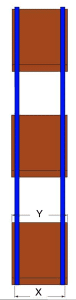
Once you’ve identified your pallet size, the next step is selecting the correct pallet racking frame depth.
As a general guide:
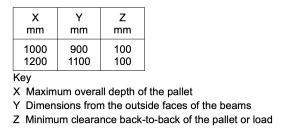
- Euro pallets are usually stored on 1100mm deep frames
- UK standard pallets are suitable for 900mm or 1100mm deep frames
- If you’re storing both UK and Euro four-way entry pallets, 1100mm deep frames offer the most versatile solution
Choosing the right frame depth ensures your pallets are properly supported while making the best use of your available warehouse space.
Don’t Forget About Pallet Condition
Even the strongest pallet racking system relies on the condition of the pallets being stored. If pallets are damaged, overloaded or have broken boards, they may need additional support to keep your goods safe.
Depending on your application, this could include:
- Wire mesh decking
- Timber decking
- Steel decking
- Pallet support bars
These accessories help improve stability and reduce the risk of damaged pallets causing accidents or product loss.
How Much Should a Pallet Overhang?
Correct pallet positioning is an important part of safe warehouse storage. With standard perimeter-based pallets, the front and rear of the pallet should normally overhang each beam by around 50mm. This helps distribute the weight evenly across the beams. If you’re using decking or pallet support bars, this overhang may not be necessary. However, too much overhang should always be avoided.
Excessive pallet overhang can:
- Put extra stress on the beams
- Cause uneven weight distribution
- Reduce pallet stability
- Increase the risk of pallets becoming dislodged
- Lead to damaged stock or racking
Likewise, pallets that are too small for the beam spacing may not receive enough support, making additional decking or pallet supports a sensible option.
Leaving the Correct Clearance
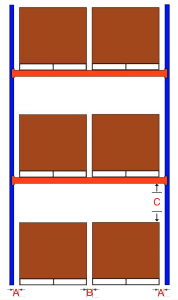
When designing a pallet racking system, it’s important to leave enough space between the pallets and the racking uprights.
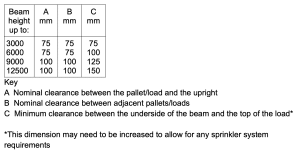
Current SEMA guidance recommends:
- 75mm clearance between the pallet and the upright for frames up to 6 metres high
- 75mm clearance between neighbouring pallets on the same beam level
- 100mm clearance for frames between 6 and 12 metres high
These clearances help reduce accidental impacts during loading while allowing forklifts to position pallets safely.
In some specialist warehouse environments, such as those using man-up trucks, different clearances may be appropriate.
Choosing the Right Pallet Racking
Selecting pallet racking isn’t just about fitting as many pallets into your warehouse as possible. The size, type and condition of your pallets all play a part in creating a storage system that’s safe, efficient and built to last. By understanding your pallet dimensions, choosing the correct frame depth, and allowing the right clearances, you’ll make better use of your warehouse space while protecting both your stock and your team.
If you’re not sure which pallet racking system is right for your business, we’re here to help. Our experienced team can advise you on pallet sizes, beam lengths, frame depths and complete warehouse storage solutions to make sure you get the best system for your needs.
Contact us or give us a call on 0800 612 3210 and we’ll be happy to help you find the right pallet racking for your warehouse.